

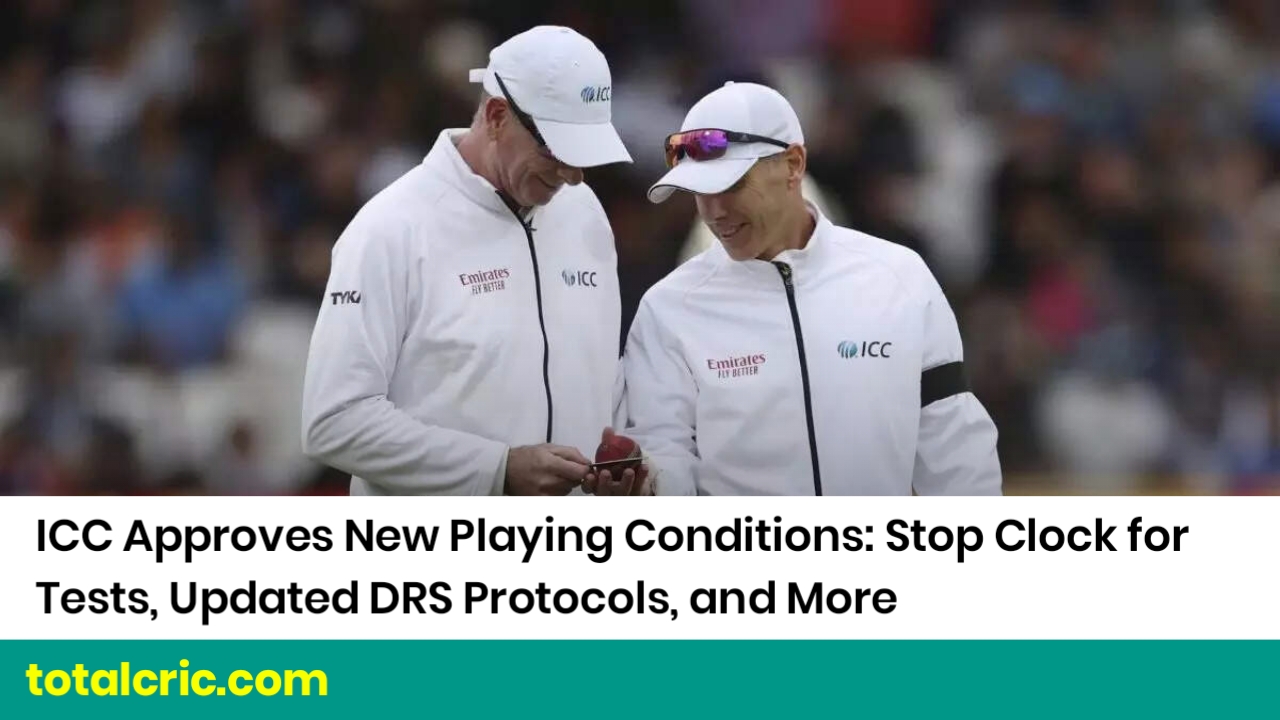
The International Cricket Council (ICC) has announced a series of significant updates to the playing conditions for men’s international cricket. While some rules are already in effect—particularly in the ongoing ICC World Test Championship 2025–27—others for the white-ball formats will take effect starting July 2, 2025.
Stop Clock Introduced in Tests
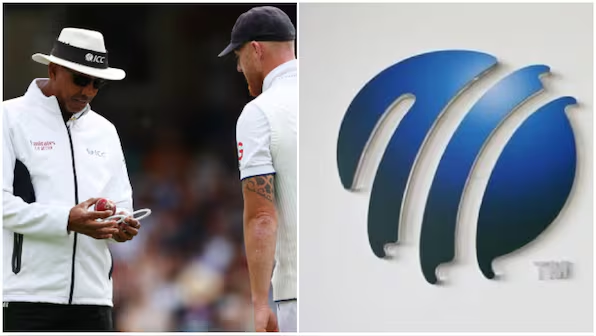
After trialling a stop clock in limited-overs cricket, the ICC has extended the measure to Test matches to address slow over rates.
How it works:
- Fielding sides must start a new over within 60 seconds of the previous one ending.
- Two warnings are allowed.
- A third breach results in a five-run penalty to the batting side.
- The warning count resets after each block of 80 overs.
This rule came into force with the start of the 2025–27 World Test Championship cycle.
Clearer Concussion Protocols
The ICC has tightened concussion management with two main changes:

- Mandatory Stand-Down Period: Players diagnosed with concussion must sit out for at least seven days before returning to play.
- Pre-Nominated Replacements: Teams must designate specific concussion substitutes before each match, reducing any advantage in selecting from a broader squad during play.
The ICC Medical Advisory Committee recommended these steps to enhance player safety.
New Wide-Ball Rule on Trial
From October 2025, a six-month trial will begin for an updated wide-ball rule in ODIs and T20Is:
- If a batter moves significantly across the crease before or during delivery, umpires will use the batter’s position at the point of delivery as the reference for judging wides.
- Balls passing between the leg stump and a newly extended protected area marker may not be called wide.
- However, any delivery behind the batter’s legs or excessively wide of the line can still be ruled a wide.
This adjustment is intended to provide bowlers more fairness when batters move late in their stance.
Changes to Saliva Rule
While using saliva on the ball remains banned, the mandatory ball change rule has been modified:
- Umpires are no longer required to automatically replace a ball contaminated with saliva.
- Instead, they will decide whether the ball’s condition warrants replacement.
- If deliberate saliva use is detected and the ball’s condition is unchanged, it will remain in play. However, the batting team will receive five penalty runs.
This update aims to prevent teams from exploiting the rule to change balls intentionally.
Revised DRS Protocols
Two key changes have been introduced to Decision Review System (DRS) procedures:
- Secondary Reviews After ‘Out’ Decisions:
- When a batter is given out caught and a review shows no contact, the TV umpire will check for a possible LBW dismissal.
- Under the new rule, if ball-tracking shows “umpire’s call,” the batter will remain out, reflecting the original decision.
- Previously, such instances defaulted to “not out.”
- Chronological Order of Reviews:
- When multiple reviews (e.g., LBW and run-out) occur on the same delivery, the TV umpire will examine them in the order they happened.
- If the first review results in dismissal, the ball is considered dead, and no further reviews are assessed.
Fairness of Catch Reviewed After No-Ball
Earlier, if a no-ball was called, the fairness of the catch wasn’t checked. Now, the TV umpire will review the catch regardless:
- If the catch is fair, the batting side gets the no-ball run plus any completed runs.
- If the catch is unfair, the runs completed by the batters will count.
Deliberate Short Runs
Under the updated rules, if a batter deliberately fails to complete a run to deceive the fielding side:
- Five penalty runs will be awarded to the fielding team.
- The fielding captain will choose which batter remains on strike.
- Batters can abort runs as long as the umpire determines there was no intent to deceive.
Full-Time Injury Replacements in Domestic Cricket
The ICC has recommended that national boards trial a full-time substitute rule in domestic first-class cricket:
- It allows a like-for-like replacement if a player suffers a visible, serious external injury (e.g., impact injuries).
- It does not apply to muscle strains or minor niggles.
- The aim is to ensure fairness without compromising safety.
When Do These Changes Begin?
- Test cricket playing conditions, including the stop clock, are already active in the WTC.
- White-ball format updates will take effect from July 2, 2025.
- The wide-ball trial starts in October 2025 and will run for six months.
These updates reflect the ICC’s focus on improving fairness, pace, and player welfare in international cricket.
Also Read : IND vs ENG: Five Costly Errors Sink India in Headingley Defeat